
Why Buy a Botanical Garden Light Show for Your Venue?
A botanical garden light show can turn quiet paths into a compelling evening destination. Visitors follow glowing borders, pause beneath illuminated trees, and discover familiar plant collections in a different way. The experience can extend opening hours, support seasonal programming, and give families a memorable reason to visit. It is not just decoration.
Botanic Gardens Conservation International (BGCI) estimates that botanic gardens worldwide receive around 500 million visits each year. That scale signals a substantial public audience, though it does not guarantee demand for every nighttime event. BGCI Secretary General Dr. Paul Smith has emphasized the importance of connecting people with plants and conservation. A thoughtfully designed light show can help make that connection vivid, especially when lighting reveals a plant’s shape without overwhelming its natural setting.
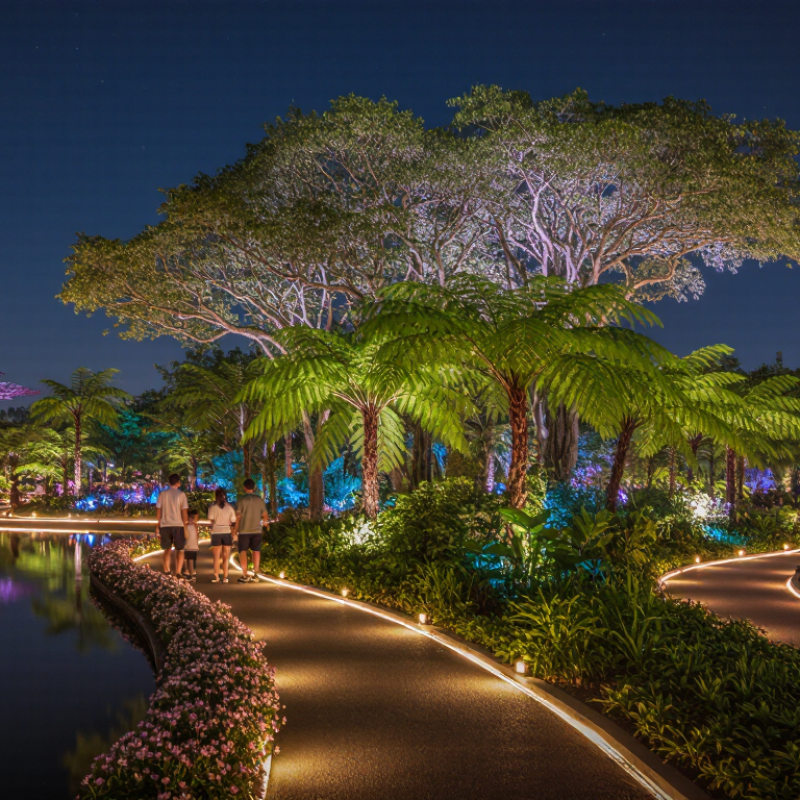
For venue operators, the practical details matter: clear routes, gentle transitions between bright and dark areas, and lighting chosen for the collection. A glowing fern trail may feel enchanting; glare across a pond may feel less so. The show should also fit the garden’s ecological priorities and maintenance capacity. There is no perfect formula. Some installations may need adjustment after visitors experience them. Done with care, a botanical garden light show can create a distinct seasonal attraction while keeping the living garden at its center.
What a Botanical Garden Light Show Includes
A botanical garden light show usually combines illuminated sculptures, pathway lighting, and a route designed around the landscape. Installations might resemble oversized flowers, glowing insects, or abstract forms among trees. Some displays use gentle audio or projected images, but these should complement the garden rather than overwhelm it. Small details matter: a low light beside a pond can reveal reflections, while a brighter feature can draw visitors toward a wider path. Keep it balanced.
The package may also include a site plan, lighting controls, power distribution, installation, and ongoing maintenance. Ask how cables will be protected, how equipment responds to rain, and who checks fixtures during opening hours. These practical details are easy to overlook. They shape the visitor experience.
A thoughtful layout accounts for accessible routes, resting points, sightlines, and crowd movement. Staff need clear procedures for faults and weather changes, too. The first design may look impressive on paper but feel crowded in a narrow garden. Walking the route after dusk can expose those problems. A quieter section may need fewer lights, not more. The best show works with the plants and paths already there, while leaving room for guests to pause, look closely, and move at a comfortable pace.
How Light Shows Transform Garden Spaces After Dark
After sunset, a botanical garden can feel newly intimate. Low, warm light reveals dew on fern tips, outlines a stone bridge, and guides visitors along winding paths. Color can shift gently between trees, while projected patterns make leaves seem to move. The garden becomes an experience, not merely a daytime attraction extended into evening. Small details matter. Keep fixtures aimed away from visitors’ eyes and sensitive habitat; darkness is part of the design, too.
A light show can also give visitors a reason to linger, take photographs, and explore familiar grounds at a different pace. The National Recreation and Park Association’s 2023 Engagement with Parks report found that 84% of U.S. adults considered parks and recreation an important local government service. That signals the value people place on shared green spaces, though a light event must still suit its site and community. Energy choices deserve the same care: the U.S. Department of Energy says LEDs use at least 75% less energy and last up to 25 times longer than incandescent lighting. Those figures compare lamps, not an entire show’s energy use. Less can work. Some paths may need only a soft pool of light, and one overlooked shadow can make the setting feel more natural.
Benefits for Visitor Engagement and Venue Revenue
A botanical garden light show can give visitors a reason to return after sunset, when familiar paths feel newly discovered. The 2023 TEA/AECOM Global Experience Index reported 242.5 million visits across the world’s 25 most-attended theme parks, up 23.1% from 2022. That signals renewed demand for in-person attractions, but it does not guarantee a garden show will sell out.
Eventbrite’s 2014 “Experience Economy” study found that 78% of surveyed millennials would choose spending on an experience over a desirable physical item. The survey is dated, so treat it as context, not a current sales forecast. For venues, timed evening tickets can extend operating hours, while optional hot drinks, dining, or seasonal memberships create additional spending opportunities. Track these separately. A busy entrance does not always mean strong per-visitor revenue.
Engagement depends on details visitors can feel: lanterns reflected in a pond, a warm drink near a greenhouse, or a quieter route for families with young children. A show can also encourage repeat visits when its lighting or program changes during the season. Still, spectacle is not enough. Poorly lit paths, long queues, or sound that overwhelms a garden’s calm can weaken the experience. Measure dwell time, return visits, and visitor feedback, then adjust. Some displays will need rethinking.
| Why Buy a Botanical Garden Light Show for Your Venue? - Benefits for Visitor Engagement and Venue Revenue | |||
|---|---|---|---|
| Planning Dimension | Illustrative Scenario | Calculation or Visitor Benefit | How the Venue Can Use It |
| Operating season | 30 event nights | A defined season creates a limited-time reason to visit and makes staffing and promotion easier to schedule. | Choose dates that suit local weather, garden operations, and the venue’s visitor calendar. |
| Event capacity | 1,200 visitors per night | Capacity is a planning assumption, not a universal standard. Safe attendance depends on paths, access, facilities, and emergency plans. | Set timed entry and admission limits based on a site-specific safety and accessibility assessment. |
| Assumed average attendance | 780 visitors per night (65% of capacity) | 30 nights × 780 visitors = 23,400 total visits in this example. | Replace the assumed attendance with ticketing forecasts informed by local demand and comparable events. |
| Event ticket revenue | $421,200 gross | 23,400 visits × $18 assumed average ticket price. This excludes taxes, refunds, discounts, and fees. | Model several ticket-price and attendance scenarios before setting prices. |
| Food and beverage sales | $98,280 gross sales | Assumes 35% of visitors make a purchase, averaging $12 per purchasing visitor: 23,400 × 35% × $12. | Offer suitable concessions where practical; estimate the venue’s retained amount after product and labor costs. |
| Retail sales | $70,200 gross sales | Assumes 20% of visitors make a purchase, averaging $15 per purchasing visitor: 23,400 × 20% × $15. | Consider garden-related gifts and event merchandise, and account for inventory and staffing costs. |
| Illustrative gross receipts | $589,680 | $421,200 ticket revenue + $98,280 food and beverage sales + $70,200 retail sales. | This is gross revenue in the example, not profit. Avoid double-counting purchases already included in admission packages. |
| Illustrative event costs | $250,000 assumed total cost | A hypothetical planning allowance for production, installation, power, labor, marketing, maintenance, and removal. | Obtain venue-specific quotes and include insurance, accessibility provisions, permits, and contingency. |
| Illustrative contribution before fixed overhead | $339,680 | $589,680 gross receipts − $250,000 assumed event costs. Actual results may be lower or higher. | Use a detailed budget; this figure is not a forecast or guarantee of profit. |
| Visitor engagement opportunities | Timed evening visits, illuminated garden routes, and optional interpretive stops | A distinct after-hours experience can encourage advance planning and give visitors new ways to explore the garden. | Track attendance by time slot, repeat visits, dwell time, visitor feedback, and accessibility issues. |
| Important: All prices, attendance rates, sales rates, and cost figures above are illustrative assumptions for a sample planning model—not observed results, industry benchmarks, or a guarantee. Replace them with venue-specific data and supplier quotes before making a purchasing decision. | |||
Which Venues Can Host a Botanical Garden Light Show
Botanical gardens and arboreta are natural fits: mature trees, winding paths, and water features give light installations a vivid setting. But suitable venues also include public parks, historic estates, zoos, resorts, and spacious campuses. Each needs safe walking routes, accessible entrances, restroom capacity, parking or transit access, and room for queues. A beautiful site is not automatically a practical one.
The National Park Service recorded 325.5 million recreation visits to U.S. national parks in 2023. That figure shows broad interest in outdoor experiences, not expected attendance for a light show. Venue planners should assess local demand, seasonal weather, staffing, power access, and nearby residents before committing. The Illuminating Engineering Society’s guidance on outdoor environmental lighting can help teams consider glare and light spill. A route that looks graceful on a map may feel confusing in rain. That deserves a site walk.
Tips: Walk the proposed route after dark. Check path width, trip hazards, emergency access, and sightlines around trees. Test a small lighting area before scaling up; crowded paths can spoil the experience.
Key Factors in Selecting and Operating a Light Show
Choosing a botanical garden light show starts with the garden itself. Walk the site after dusk and note narrow paths, low branches, ponds, and places where visitors may stop for photos. Keep paths clear. Check whether lighting could disturb sensitive planting or wildlife, and avoid aiming bright beams toward homes or roadways. A small on-site mock-up can reveal glare that looks harmless on a daytime plan.
Match the equipment to local conditions and the venue’s operating capacity. Ask suppliers for weather ratings, power loads, connection plans, and replacement-part availability. Map cable runs away from public walkways, then have a qualified technician review the setup. Rain changes everything. Wet leaves can hide trip hazards, while wind may shift lightweight fixtures. A forecast is useful, but it cannot replace daily inspections.
Plan staffing and visitor flow before opening night. Set a clear route, estimate how long guests will spend at each display, and place staff where queues could block paths. Provide a simple procedure for dimming or shutting down a section if a fixture fails. Test it after dusk. One detail is easy to miss: a display can look beautiful in an empty garden yet feel crowded when families pause beneath it. Adjusting the layout after a trial evening may be necessary, even if that means reworking part of the plan.
Why Buy a Botanical Garden Light Show for Your Venue?
Key Factors in Selecting and Operating a Light Show
How to use this chart: Energy use is calculated for an illustrative 10 kW lighting load using energy (kWh) = power (kW) × operating time (hours). A longer runtime increases energy consumption; use your planned fixture load and schedule to estimate actual operating costs.