Top 10 Types of Kids Puzzle Toys for Global Sourcing
Global sourcing for Kids Puzzle Toys requires more than attractive colors and low factory prices. Buyers must examine developmental value, material quality, age suitability, safety documentation, and supplier consistency. A wooden animal puzzle should have smooth edges, secure printing, and pieces that fit small hands. A magnetic set needs strong connections and careful packaging. Small details can shape a child’s entire play experience.
Maria Montessori, a leading educational expert, wrote, “The hands are the instruments of man’s intelligence.” This idea remains valuable when evaluating puzzle toys. Well-designed puzzles let children touch, compare, rotate, test, and try again. They can support problem-solving, hand-eye coordination, vocabulary, patience, and early spatial thinking. However, not every puzzle delivers meaningful learning. Some look educational but offer repetitive play. Buyers should question attractive claims and request clear evidence from suppliers.
This guide explores ten major types of Kids Puzzle Toys for international sourcing. It considers wooden puzzles, jigsaw puzzles, peg puzzles, floor puzzles, 3D construction puzzles, magnetic puzzles, matching games, logic puzzles, sensory puzzles, and customizable designs. Each category has different manufacturing needs, packaging concerns, and retail potential. Supplier audits, reliable test reports, traceable materials, and transparent communication remain essential. Trends can change quickly. Children’s real preferences may surprise even experienced buyers. A puzzle that performs well in one market may feel too difficult, too simple, or culturally unfamiliar elsewhere. Good sourcing leaves room for careful testing, honest feedback, and occasional revision.
What Defines a Kids Puzzle Toy?
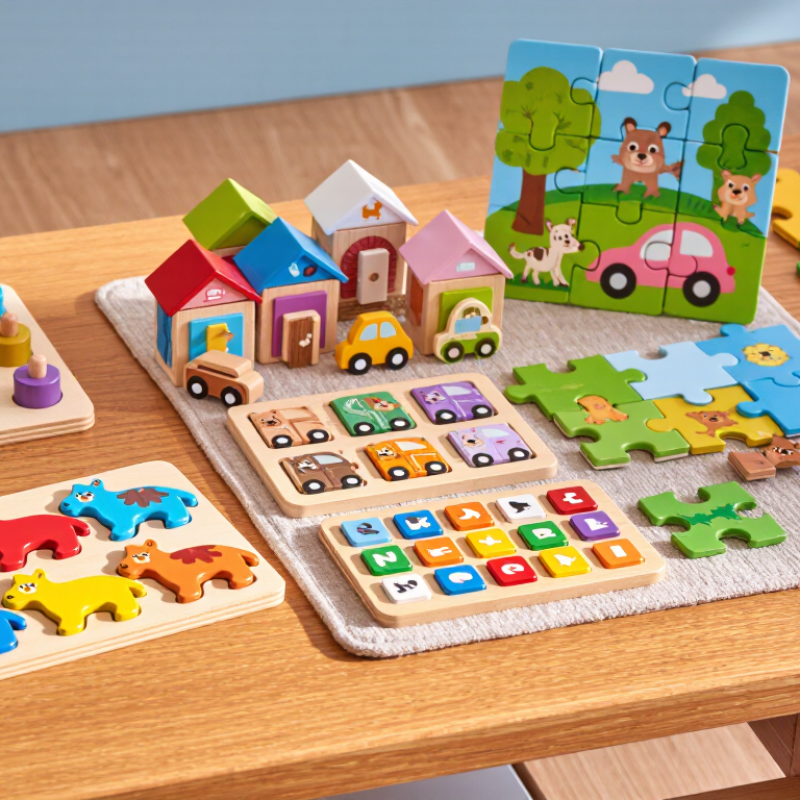
A kids puzzle toy is more than a box of colorful pieces. It is a hands-on play product that invites children to observe, compare, arrange, and solve. The best designs match the child’s age, attention span, and developing motor skills. Large wooden pieces may suit toddlers, while smaller interlocking parts can challenge older children. However, age labels should never replace careful judgment.
During product evaluation, I check piece thickness, edge smoothness, color durability, and resistance to repeated handling. A puzzle should feel satisfying, not frustrating. Clear visual clues help beginners, while layered patterns or spatial shapes offer deeper challenge. Materials also matter. Wood, cardboard, and plastic each create different textures and durability levels. Some puzzles look attractive in photographs but feel weak during actual testing. That gap deserves attention.
Tips: Test samples with children from the intended age group. Watch how they hold, sort, and store each piece. Check for loose parts, sharp corners, peeling surfaces, and confusing instructions. Ask whether the challenge remains enjoyable after several attempts. A small mistake in piece sizing can affect both safety and play value. Sourcing teams should request material details, production records, and independent safety test reports before placing large orders. Balancing educational value, durability, and realistic manufacturing costs is not always easy. Even experienced buyers may overlook packaging strength or missing language instructions. Recheck the details.
How Kids Puzzle Toys Are Classified by Design and Skills
Top 10 Types of Kids Puzzle Toys for Global Sourcing
How Kids Puzzle Toys Are Classified by Design and Skills
Kids puzzle toys are best classified by the skills they develop, not only by shape. Jigsaw puzzles build visual matching and patience. Peg puzzles support hand-eye coordination. Wooden shape sorters strengthen spatial awareness. Maze boards encourage planning and controlled movement. Logic puzzles introduce sequencing, memory, and simple problem-solving. Construction puzzles add creativity through balance, connection, and repeated trial.
Age suitability also matters. Large knobs and thick pieces fit younger children, while smaller interlocking parts suit older users. According to Circana’s 2024 global toy industry review, worldwide toy sales declined about 7% in 2023 across major markets. This pressure makes clear product positioning important. A puzzle with one obvious function may struggle. A modular design may serve several learning stages, although too many features can confuse children. I have seen buyers overvalue colorful packaging and underestimate piece durability. That mistake deserves more attention.
Tips: Ask suppliers for age-grade testing records, material declarations, and drop-test samples. Check whether pieces remain easy to grip after repeated use. Compare challenge levels through real child play, not catalog descriptions. Reports from Grand View Research identify educational toys as a growing market, but growth does not guarantee quality. Verify claims carefully. A bilingual instruction card can improve usability in export markets, yet visual instructions are often safer and clearer.
Top 10 Types of Kids Puzzle Toys for Global Sourcing
Top 10 Types of Kids Puzzle Toys for Global Sourcing
Global sourcing teams can build a balanced puzzle range around ten practical types: jigsaw puzzles, peg puzzles, shape sorters, stacking puzzles, tangrams, maze puzzles, logic boards, matching games, word puzzles, and three-dimensional construction puzzles. Each type supports a different skill, from hand coordination to spatial reasoning. Grand View Research valued the global educational toys market at approximately US$57 billion in 2023, with strong projected growth through 2030. That figure suggests sustained demand, but it does not guarantee success for every puzzle design.
Age grading matters. A toddler’s chunky wooden peg puzzle needs large pieces, smooth edges, and easy cleaning. Older children may prefer compact travel mazes, magnetic logic boards, or layered jigsaws with 100 pieces. The Toy Association reported that United States toy sales reached about US$28.6 billion in 2023, despite an annual decline. Buyers therefore need sharper product selection, not simply more products.
Material choices also affect sourcing: responsibly managed wood, durable cardboard, and tested water-based coatings can improve trust. Packaging should show piece count, age range, dimensions, and language requirements clearly. Small parts remain a serious concern. A clever puzzle can still fail in a real home. Supplier audits, sample testing, and batch inspections reduce that risk, although they cannot replace careful human judgment.
Key Factors for Evaluating Global Puzzle Toy Suppliers
Global puzzle toy sourcing requires more than attractive artwork and low factory prices. Supplier quality should be tested against safety, consistency, and delivery evidence. The 2024 Circana Global Toy Report recorded a 7% decline in worldwide toy sales during 2023. This pressure makes reliable sourcing even more important.
Ask suppliers for recent test reports covering relevant standards, such as ASTM F963, EN71, or ISO 8124. Check whether reports match the exact puzzle material, coating, age grade, and packaging. A wooden puzzle may look harmless, yet loose paint or small detachable pieces can create serious risks. Review factory audit records, production capacity, and corrective-action history. One successful sample proves very little. Request three samples from separate production runs when possible. Inspect edge smoothness, piece fitting, print alignment, odor, and box compression. These details reveal process control better than a polished catalog.
Tips: Build a supplier scorecard with safety compliance, defect rate, lead time, communication, and traceability. Require batch codes and retained samples. The International Organization for Standardization emphasizes risk-based product evaluation, but practical factory checks still matter. I have found that video inspections can miss dust, rushed assembly, or weak carton sealing. An independent pre-shipment inspection is safer. Do not judge suppliers only by certificates; verify issuing laboratories and report dates. A cheaper quotation may hide higher rework, replacement, and customs risks. Reconsider your scoring weights after every shipment. Mistakes are useful, if documented.
Top 10 Types of Kids Puzzle Toys for Global Sourcing
Key Factors for Evaluating Global Puzzle Toy Suppliers
The benchmark score combines five practical sourcing factors: child-safety compliance, material consistency, age-appropriate design, packaging efficiency, and production scalability. Wooden peg puzzles and jigsaw puzzles score highly because they support repeatable manufacturing, broad age coverage, and efficient packaging. Suppliers should also be checked for third-party safety testing, traceable materials, reliable quality control, export documentation, and realistic minimum order quantities.
