10 Lace Brassiere Buying Tips for Global Buyers?
Buying a Lace Brassiere for international markets requires more than attractive patterns and a competitive quotation. Global buyers must assess fabric quality, stitching, fit consistency, supplier reliability, and customer expectations before placing a large order. A delicate lace edge may look elegant in a sample but curl after washing. Small details matter.
This guide presents ten practical buying tips based on common sourcing experience and professional quality-control practices. It explains how to check lace composition, lining softness, elastic recovery, hook-and-eye strength, size grading, and colorfastness. Buyers should request clear product specifications, production samples, inspection records, and packaging details. Supplier communication also deserves close attention. Slow replies, vague measurements, or changing material descriptions may signal avoidable risks.
Think beyond the first shipment.
A dependable supplier should discuss minimum order quantities, lead times, defect handling, and reasonable quality standards openly. Buyers should also confirm whether product claims, labeling, testing, and packaging meet the requirements of their destination markets. These requirements can differ, so professional review may be necessary. No checklist guarantees a perfect purchase. Real products sometimes reveal issues that samples hide, especially after repeated washing and extended wear. That is why buyers should keep inspection evidence, compare batch results, and improve their evaluation process over time. A beautiful Lace Brassiere is valuable only when comfort, durability, presentation, and responsible supply practices remain consistent across every order.
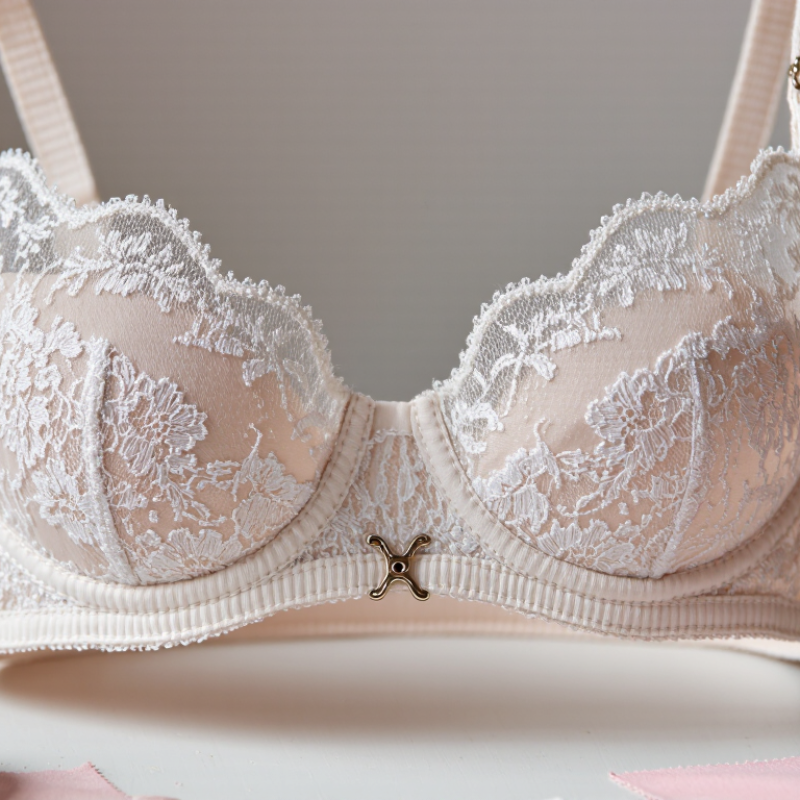
Understanding Lace Brassiere Types and Construction
Lace brassieres differ mainly by lace type, stretch, and support structure. Raschel lace is durable and cost-efficient for larger production runs. Leavers-style lace offers finer detail, but its delicate yarns require stricter inspection. Tricot lace feels smoother against skin. Buyers should request samples showing the lace alone, then assembled on the cup.
Construction matters more than appearance. Check whether the lace contains elastane, and measure recovery after repeated stretching. Textile Exchange’s Materials Market Report 2024 states that polyester represented 57% of global fiber production in 2023, while polyamide accounted for 5%. Fiber content affects softness, drying speed, and dye consistency. Ask suppliers for fiber percentages, colorfastness results, and seam-strength records. Small details matter.
Inspect the underband, bridge, cup lining, and strap attachment. A narrow elastic may curl after washing, especially under high heat. A stable lining can improve support, but it may reduce breathability. Grand View Research estimated the global lingerie market at approximately USD 94 billion in 2023, reflecting strong demand but also intense quality pressure. A larger market does not guarantee better construction. Request wash tests, dimensional measurements, and photos after testing. A swatch can still mislead. That is where buyers often under-test.
Evaluating Quality, Safety, and Product Certifications
For global buyers, lace brassiere quality begins with fibers, stitching, and skin-contact safety. A soft hand feel is not proof of safe chemistry. Request test results for colorfastness, pH, formaldehyde, restricted azo dyes, and nickel release. Check the hooks, adjusters, and underband closely. Rough edges can cause irritation after several hours. The European Commission’s 2023 Safety Gate report recorded 3,412 product alerts. Clothing, textiles, and fashion items represented 8% of notifications. That figure makes traceability more than paperwork. Ask for the production lot, testing date, laboratory identity, and certificate scope. Do not trust a logo alone.
Textile Exchange’s 2024 Materials Market Report estimated global fiber production at 124 million tonnes in 2023. Recycled fibers accounted for about 12.5%. If recycled lace or elastane is claimed, request transaction records and certified-content evidence. A certificate should match the exact material, factory, and product category. For laboratory reports, prefer facilities accredited to ISO/IEC 17025. Confirm the report covers the destination market, because chemical limits differ. One practical mistake is testing only the lace. Hooks, dyes, elastic, and adhesives also touch skin. I would not call this foolproof. Perfect paperwork can still hide a changed supplier or fabric batch. Re-test the production lot.
