
How to Choose the Best Weight Plate Storage Racks
Choosing the right Weight Plate Storage Racks can transform a crowded training area into a safer, more efficient space. Plates should remain easy to reach, stable during loading, and protected from unnecessary floor contact. A practical rack reduces tripping hazards and helps athletes return equipment consistently after each session.
The best choice depends on plate diameter, total weight, available floor space, and training frequency. A commercial gym may need a heavy-duty vertical rack with reinforced posts and wide storage pegs. A home user might prefer a compact horizontal unit that fits beside a power rack. Steel thickness, weld quality, base design, and weight capacity deserve careful attention. Rubber feet can reduce movement and protect concrete or wooden flooring. Small details matter.
Real-world use often reveals weaknesses that product photos hide. A rack may look strong but wobble when several plates are removed quickly. Peg spacing may also limit access to bumper plates or large competition discs. Measure your plates before ordering. It sounds obvious, yet this mistake happens often. Check whether the rack remains balanced when loaded unevenly, especially in busy training areas. Reliable manufacturers provide clear dimensions, tested capacity information, and practical assembly instructions. Still, specifications should not replace judgment. Inspect bolts, welds, and floor contact points regularly. The ideal Weight Plate Storage Racks solution supports safer habits without consuming valuable training space. It should feel stable, quiet, and simple to use every day.
Classify Plates by Industry Standards: 50 mm Olympic vs 25 mm Standard Bores
Choosing the best weight plate storage rack starts with the plate bore, not the plate color or total weight. In most gyms, plates use either a 50 mm Olympic bore or a 25 mm standard bore. These sizes are not interchangeable. A 50 mm plate needs a wider storage peg, while a 25 mm plate fits a narrower peg.
I learned this after placing standard plates on an Olympic-style rack. They looked secure, but they moved too much during loading. That small gap created noise and made the plates harder to organize. Measure the center hole with calipers when possible. Nominal sizes can vary slightly between manufacturers. Do not rely only on labels.
For Olympic plates, choose a rack with strong, wide pegs and enough clearance for thick bumper plates. For standard plates, narrower pegs usually provide a tighter fit. Check the rack’s rated capacity, weld quality, base width, and floor contact points. A loaded rack should not rock when one plate is removed. It should also leave room for your hands between neighboring plates. This detail is often missed.
Keep each bore type on separate pegs and label the sections clearly. Store heavier plates lower when the rack design allows it. I still prefer a little unused space, even when storage seems limited. Overfilled pegs slow down training and can damage edges over time. A compact rack is useful, but only when access remains controlled.
Measure Plate Dimensions Using Typical 450 mm Olympic Plate Diameters
The 450 mm Olympic plate diameter is a useful starting point for selecting a storage rack. The International Weightlifting Federation’s 2024 Technical and Competition Rules specify 450 mm as the maximum diameter for standard competition discs. However, not every plate reaches that size. Smaller plates may use different diameters and thicknesses.
Measure every plate before ordering. Place one plate flat on the floor and measure across its widest point, passing through the center hole. Record the thickness at the rim, not near the hub. A rack designed for 450 mm plates should provide slightly more than 450 mm of vertical clearance. I recommend allowing 20–30 mm for lifting, alignment, and manufacturing variation. The International Organization for Standardization also emphasizes dimensional tolerances in equipment design, so published measurements should not be treated as exact physical limits.
The center hole matters too. Many Olympic-style plates use an approximately 50 mm opening, but sleeve dimensions can vary. Measure the rack’s storage peg diameter and usable length. Leave space between neighboring plates, especially for thick bumper plates. A practical error is measuring only the largest plate. I have seen layouts fail because the peg was long enough, but the plates touched the frame. Recheck the loaded rack at floor level. Human handling is less precise than a drawing.
Calculate Rack Capacity from Plate Weight, Thickness, and Load Ratings
How to Choose the Best Weight Plate Storage Racks
The Health & Fitness Association’s 2024 Global Report recorded about 184 million fitness facility members worldwide in 2023. More plates require more controlled storage. Start with total load, not appearance.
Use this formula: total plate weight equals plate count multiplied by each plate’s weight. For example, twenty 45-pound plates create a 900-pound load. A rack rated for 1,000 pounds leaves only 100 pounds of margin. That is too close for busy facilities. A safer planning target uses no more than 80–90% of the stated rating. Check each peg separately. Ten plates, each 2 inches thick, need 20 inches of usable peg length. Add clearance for collars and hand movement. Actual thickness differs between plate types, even with identical weights. That small detail causes frequent ordering mistakes.
Tips: Measure real plates before purchasing. Confirm total capacity, per-peg capacity, weld quality, and floor compatibility. Review the manufacturer’s test method, not only its headline rating. ASTM F2276 provides useful fitness-equipment safety guidance, but it does not replace site-specific inspection. The ACSM Worldwide Survey has consistently identified strength training as a major fitness trend, so storage demand may rise. Still, a neat spreadsheet can mislead. Plates are often loaded unevenly. Users may drop them onto pegs. Leave room for future additions, and recheck the rack after installation.
Compare Storage Designs: Peg, Vertical, Horizontal, and Tree-Style Racks
How to Choose the Best Weight Plate Storage Racks
Choosing a weight plate rack depends on room shape, plate size, and lifting habits. Peg racks keep plates separated on horizontal pins, making weight selection quick. They work well beside a power rack or lifting platform. However, overloaded pegs can bend or make the frame unstable. Check the rated capacity carefully.
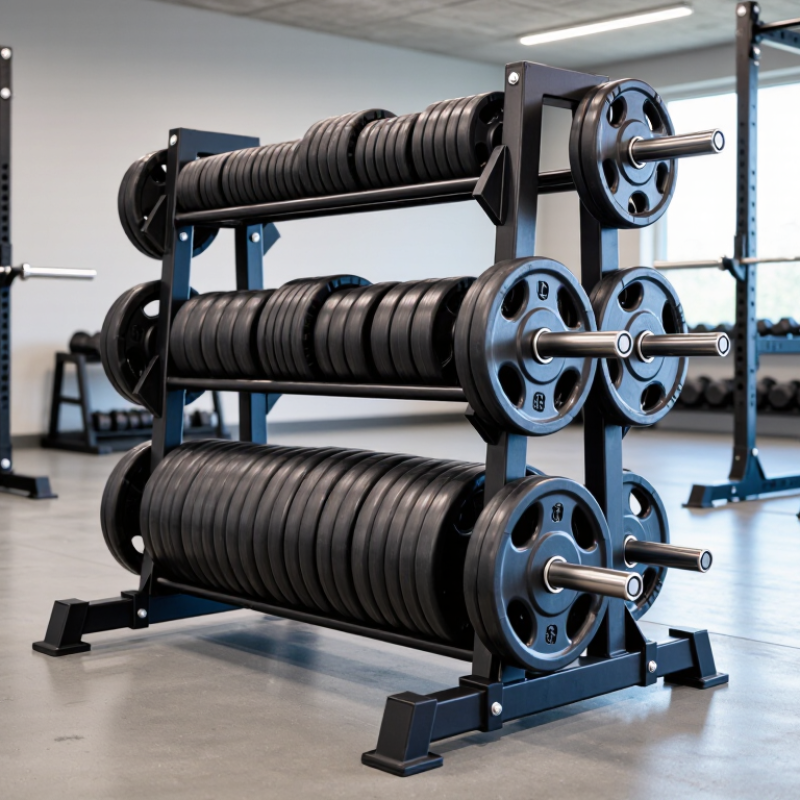
Vertical racks use floor space efficiently and suit narrow home gyms. Plates stand upright, so the floor stays easier to clean. Horizontal racks are steadier for heavier collections, but they need more space and may limit walking paths. Tree-style racks offer several angled pegs on one compact frame. They look organized and allow fast access, though uneven loading can tilt the unit. I have found that small plates often disappear behind larger ones. That minor issue becomes frustrating during busy sessions.
Tips: Measure the rack footprint and door clearance first. Leave enough room to lift plates safely. Place heavier plates on lower pegs when possible. Inspect welds, bolts, and rubber feet regularly. A rack may appear strong, yet poor flooring can cause movement. I once chose a compact design that seemed ideal, but its short pegs crowded bumper plates. A larger model would have been more practical. Some decisions only become clear after daily use.
How to Choose the Best Weight Plate Storage Racks - Compare Storage Designs: Peg, Vertical, Horizontal, and Tree-Style Racks
| Comparison Dimension | Peg Rack | Vertical Rack | Horizontal Rack | Tree-Style Rack |
|---|---|---|---|---|
| Basic design | Individual pegs or sleeves hold plates on a wall-mounted or compact freestanding frame. | Plates are stored upright on vertical posts, usually with the plate faces parallel to the frame. | Plates rest on horizontal shelves, trays, or rails arranged in one or more levels. | A freestanding central frame uses several angled or horizontal pegs branching from a vertical support. |
| Typical footprint | Approximately 8–18 in. deep; wall-mounted versions use very little floor space. | Approximately 18–30 in. wide and 18–30 in. deep. | Approximately 24–48 in. wide and 18–30 in. deep, depending on the number of shelves. | Approximately 20–32 in. wide and 20–32 in. deep. |
| Typical storage capacity | About 100–300 lb total for compact units; capacity depends heavily on the number of pegs and wall or frame construction. | About 150–400 lb total for common freestanding units with several storage posts. | About 200–600 lb total for heavy-duty multi-level units with evenly distributed loads. | About 150–400 lb total, depending on the number of pegs, base size, and frame rating. |
| Best plate organization | Separate plates by diameter, weight, or use frequency on dedicated pegs. | Group similar plates on each post; useful when plates have compatible center-hole sizes. | Organize plates in horizontal rows by weight, diameter, or lifting station. | Keep frequently used plates on accessible outer pegs and heavier plates on lower positions. |
| Floor-space efficiency | ★★★★★ Excellent, especially when wall-mounted. | ★★★★☆ Very good use of vertical space. | ★★★☆☆ Requires more floor length and depth. | ★★★★☆ Compact for the amount of storage provided. |
| Plate access | Fast access when each peg is assigned to a plate size; stacked plates can require more handling. | Good access from the side, although plates may need to be lifted over other plates on the same post. | Very easy access because plates are separated on shelves or rails. | Quick access to individual plates, but closely spaced pegs can limit hand clearance. |
| Stability considerations | Wall-mounted models require suitable anchors and a structurally sound wall; freestanding models need a stable base. | A wide base, level floor, and balanced loading help prevent tipping. | Evenly distribute plates across shelves and confirm that the frame is rated for the intended load. | Place heavier plates on lower pegs and use a broad, stable base to reduce tipping risk. |
| Loading and unloading effort | Low to moderate; depends on peg height and how many plates are stacked together. | Moderate; plates are lifted vertically onto posts. | Low; shelves generally reduce the need to lift plates over a tall stack. | Low to moderate; lower pegs are easiest to use, while high pegs require more reach. |
| Ideal for | Small home gyms, wall-based storage, and users who want dedicated locations for different plate sizes. | Compact gyms that need upright storage and a relatively small floor footprint. | Commercial-style rooms, larger plate collections, and users who prioritize easy visibility and access. | Home gyms and lifting areas that need portable, visually organized storage near a rack or platform. |
| Primary advantages | Space-saving, modular, and easy to expand when additional pegs are available. | Good capacity-to-footprint ratio and clear separation between plate groups. | Excellent visibility, convenient access, and strong organization for several plate sizes. | Compact, portable, and convenient for frequently used bumper or iron plates. |
| Common limitations | Wall installation may be required; overloaded pegs can damage hardware or the mounting surface. | Stacking several plates on one post can make heavier plates difficult to remove. | Uses more floor space and may be less suitable for narrow training areas. | Can become unstable if loaded unevenly or if heavy plates are placed on upper pegs. |
| Selection priority | Choose this design when minimizing floor space is the main goal. | Choose this design when you want upright storage with a moderate footprint. | Choose this design when plate visibility and effortless access matter most. | Choose this design when portability, compact organization, and quick access are important. |
Verify Safety Features Against Manufacturer Load Limits and ASTM Practices
How to Choose the Best Weight Plate Storage Racks
A storage rack is not automatically safe because it looks heavy. Check the manufacturer’s stated load limit for each peg, shelf, and the complete frame. A 20-kilogram plate placed repeatedly can create impact forces beyond its static weight. ASTM F2276 provides safety guidance for fitness equipment, but it does not universally certify every weight plate rack. Treat ASTM practices as a reference, not a replacement for product-specific testing.
The SFIA 2024 Topline Participation Report recorded 242.1 million Americans participating in at least one sport, fitness, or leisure activity during 2023. More equipment in use means greater demand for stable, clearly rated storage. Select racks with wide bases, secured feet, welded joints, and visible capacity labels. Confirm whether the limit assumes evenly distributed plates. It often does. A narrow rack may tip when heavy plates are loaded on one side. That detail is easy to miss.
Tips: Measure the available floor area first. Keep the heaviest plates closest to the base. Ask for test records, inspection intervals, and anchoring instructions. Check bolts after initial use. Slight movement deserves attention. ASTM F2571 test methods may help assess fitness-equipment stability and durability, but the rack’s own instructions remain essential. I would also leave a safety margin below the published limit; real gyms are rarely as careful as spreadsheets suggest.