How to Choose the Best Cantilever Umbrella in 2026?
Choosing a Cantilever Umbrella in 2026 starts with the space you need to shade, not the largest canopy on display. Measure your patio, table, and walking paths before comparing models. A 10-foot canopy may cover a dining set, yet its base can take up valuable floor space. Measure first.
A well-chosen Cantilever Umbrella should suit your climate, daily routine, and available storage. Check the canopy fabric’s UV and water-resistance details, and read the frame and base specifications closely. Look for clear information about wind limits, anchoring, and care. These details matter more than a polished product photo. If you live in a breezy area, confirm how the umbrella should be secured and when it must be closed. No patio umbrella should be treated as storm-proof.
Next, consider how the mechanism feels in ordinary use. Can you rotate or tilt the canopy without moving the table? Is the crank comfortable, and can you reach it easily? Compare warranties, replacement-part availability, and cleaning instructions, too. A lower price may not be a bargain if the canopy is difficult to replace. I would not pretend one design fits every patio; even a sturdy model can feel awkward when its base blocks a doorway.
This guide explains how to compare size, materials, stability, operation, and value in 2026. Use the listed specifications as a starting point, then check them against your own measurements and conditions. A little doubt is useful. A careful fit lasts longer.
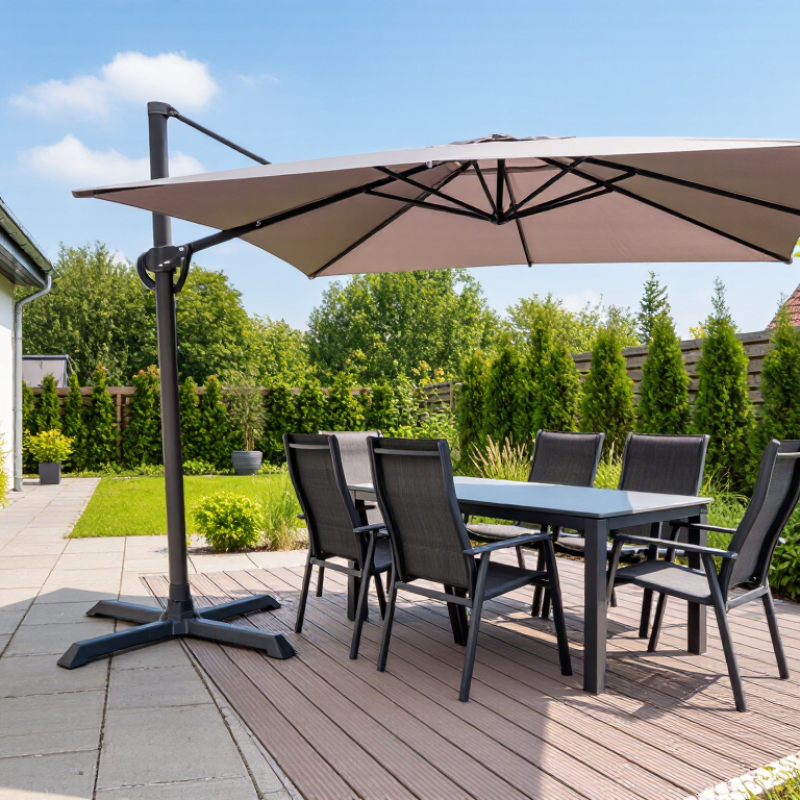
Define the Required Shade Area, Clearance, and Mounting Position
Before comparing cantilever umbrellas, map the area that needs shade. Measure the table, chairs, or lounge furniture, then add space for people to move around comfortably. A canopy’s stated diameter does not guarantee equal shade at every hour; the sun’s angle shifts coverage across the day. Measure twice. Note when the patio gets strongest sun, and check that the shaded area still covers the seats you use most.
Next, check clearance above and around the proposed position. Look for eaves, tree branches, light fixtures, doors, and nearby walkways. Open the canopy fully and trace where its ribs and support arm will extend. Leave room. A layout that fits on paper can feel cramped once chairs are pulled out. I have found that marking the canopy’s footprint with string or chalk makes tight corners easier to judge, though it is not a perfect substitute for seeing the umbrella open.
Choose a mounting position that keeps the support out of the main traffic path while letting the canopy reach the target area. A freestanding base offers flexibility but takes up floor space; a fixed mount can save space, but the surface must suit the installation. Check the deck or patio structure before drilling, and follow the manufacturer’s load and mounting instructions. If the position only works with furniture pushed awkwardly aside, reconsider it. That detail is easy to miss.
How to Choose the Best Cantilever Umbrella in 2026? — Define the Required Shade Area, Clearance, and Mounting Position
| Use Area | Approximate Area to Shade | Suggested Canopy Size | Approximate Canopy Projection | Clearance to Check | Mounting Position |
| Small bistro set | About 6 × 6 ft (36 sq ft) | 9 ft round | About 64 sq ft | Allow room for the canopy to rotate and tilt without striking walls, railings, or overhead fixtures. | Place the pole just outside the table footprint, with the canopy centered over the seating area. |
| Four-seat dining set | About 8 × 8 ft (64 sq ft) | 10 ft round or 10 × 10 ft square | About 79 sq ft round; 100 sq ft square | Check the open canopy’s lowest edge and the full sweep of the ribs during rotation and tilt. | Position the base beside the table rather than beneath it; confirm the arm can reach the table center. |
| Large dining table or conversation area | About 10 × 10 ft (100 sq ft) | 12 ft round or 10 × 12 ft rectangular | About 113 sq ft round; 120 sq ft rectangular | Measure from the ground to the lowest part of the open canopy, and allow extra space for the moving canopy. | Locate the base on the side where it will not obstruct chairs, walkways, doors, or traffic around the table. |
| Wide lounge or sectional seating | About 12 × 12 ft (144 sq ft) | 13 ft round or a comparably sized rectangular canopy | About 133 sq ft for a 13 ft round canopy | Verify the required overhead and side clearance against the selected model’s open and tilted dimensions. | Set the pole outside the seating footprint and orient the arm so the canopy covers the main seating zone. |
| Long, narrow patio zone | About 8 × 12 ft (96 sq ft) | 10 × 12 ft rectangular | About 120 sq ft | Check clearance along the canopy’s full length, especially near fences, exterior walls, and neighboring furniture. | Align the long canopy side with the patio zone and keep the base clear of the main walking route. |
Planning note: Canopy projection is an approximate plan-view area (for a round canopy, π × radius²). Actual ground shade changes with the sun’s angle, canopy tilt, and time of day. Confirm the specific umbrella’s dimensions, operating clearances, mounting requirements, and base or anchoring instructions before purchase; close the canopy in strong winds and when not in use.
Compare UPF Ratings: UPF 50+ Blocks at Least 98% of UV Radiation
When choosing a cantilever umbrella, check the canopy’s UPF rating, not just its color or thickness. UPF 50+ fabric blocks at least 98% of ultraviolet radiation under test conditions. That makes it a strong choice for a sunny patio, but it does not make shade complete sun protection. UV can reach skin from the sides or reflect off pale paving and water. Small details matter. Look for a clear rating on the product label, then consider canopy size, tilt range, and how securely the base can be weighted. A wide canopy may cover a table well, yet leave chairs exposed when the sun moves.
Tips: Check the label. Choose UPF 50+ fabric and enough canopy width for your seating area. Adjust the tilt as the sun shifts, and use sunscreen and protective clothing during long outdoor periods.
Fabric quality and construction also affect how well an umbrella serves you over time. Check seams, vents, and the frame for sturdy, weather-suitable materials. A vent can help wind pass through, but it does not make an umbrella safe in strong gusts; close it when conditions worsen. I still find canopy size easy to underestimate: measure the space with chairs pulled out, not tucked in. And remember, a UPF rating applies to the fabric, while real protection depends on coverage, position, and use.
How to Choose the Best Cantilever Umbrella in 2026?
Compare fabric UPF ratings by the percentage of UV radiation they block.
UV blocked is calculated as 100 × (1 − 1 ÷ UPF). UPF 50+ blocks at least 98% of UV radiation. Actual shade also depends on factors such as umbrella coverage, sun angle, and reflected UV.
Assess Wind Stability Using Tested Limits, Base Specs, and Anchoring
For “How to Choose the Best Cantilever Umbrella in 2026,” treat wind ratings as test results, not guarantees. Ask what wind speed was tested, whether the canopy was open, and how the base was secured. ASCE/SEI 7-22 uses a velocity-pressure relationship proportional to wind speed squared. In a simplified calculation, pressure rises from about 1.0 psf at 20 mph to 2.3 psf at 30 mph. Actual umbrella loads also depend on canopy shape, exposure, and other factors. The NOAA National Weather Service Beaufort Wind Scale classifies 19–24 mph as a fresh breeze. That is a useful caution point, not a universal closing threshold.
Check the base’s stated weight and whether it needs bolts, ballast, or both. A heavy base on smooth paving can still shift or tip; anchoring must match the surface and the umbrella’s instructions. Look for clear test conditions and a tested wind limit. If a seller gives only a single wind number, without explaining the setup, I would treat it cautiously. These details are easy to overlook.
Tips: Close the canopy before gusts arrive, not after it starts twisting. Recheck bolts and ballast after moving the umbrella. Small detail. A forecast is not a site test, and gusts can exceed average wind speeds.
Compare Frame Materials and Fabric Using ASTM G154 or ISO 105-B02 Results
A cantilever umbrella works hard in direct sun. Its frame must resist bending under a tilted canopy, while its fabric must keep color and strength through repeated exposure. Aluminum is lighter and easier to reposition; steel is heavier, so check its coating and joints for scratches or corrosion. Neither material is automatically best. A wide canopy can place substantial leverage on the mast, especially when gusts catch its edge.
Use test evidence to compare fabrics, not vague claims such as “UV resistant.” ASTM G154 describes controlled exposure to fluorescent ultraviolet light and moisture, but it does not provide one universal pass score. Compare samples tested under the same lamp, cycle, and exposure duration.
ISO 105-B02 uses xenon-arc exposure and blue-wool references rated from 1 to 8; 8 indicates better colorfastness than 1. That matters. A fabric’s rating can help distinguish fading resistance, but it does not prove resistance to tearing, mildew, or water penetration.
Ask for the full test conditions and results, including fabric color and any change in strength. ASTM and ISO methods are useful, but results from different setups are not directly interchangeable. Look closely at seams and reinforced corners, too: these are common stress points on a canopy pulled taut over curved ribs.
One detail is easy to miss. A dark fabric may show fading sooner, while a pale one can still weaken without an obvious color change. Test data narrows the choice; real shade, wind, and care still matter.
Check Operation, Replacement Parts, and Warranty Coverage Before Buying
A cantilever umbrella should feel controlled, not awkward, when you open, tilt, and rotate it. If possible, try each movement before buying. Test it twice. Notice whether the crank catches, the canopy swings freely, and the locking pin holds its position. A smooth first lift can still hide a stiff tilt mechanism, so check more than once. I would not treat a quick showroom test as proof of long-term ease; that judgment can be too quick.
Ask whether commonly needed replacement parts are available separately. These may include canopy fabric, ribs, a crank handle, cables, and tilt hardware. Check how the parts are identified and ordered, and whether you can find clear instructions for fitting them. A small broken component should not force you to replace the whole frame. Keep that in mind. Also ask whether parts are stocked locally or must be shipped, since waiting weeks can leave a patio exposed.
Read the warranty terms before paying, not after a problem appears. Check the coverage period for the frame, canopy, and moving parts, because they may differ. Look for exclusions involving fading, wind damage, corrosion, or normal wear, and note whether proof of purchase is required. Ask who handles a claim and whether shipping or labor costs are covered. A long warranty sounds reassuring, but its details matter more.
