Who Are China’s Top Composite Pickleball Paddle Suppliers?
China has become a major sourcing destination for Composite Pickleball Paddles, but “top supplier” means more than a polished product photo. Buyers need to compare construction, production consistency, customization, and communication. Small details matter: edge-guard alignment, grip wrapping, surface finish, and whether paddle weights stay consistent across a batch. Some differences are easy to miss until play begins.
Paddle reviewer Chris Olson of Pickleball Studio offers a useful testing principle: “Judge the paddle in play, not only by its specifications.” This is an editorial paraphrase, not a verbatim quotation. It captures an important point for buyers: material names alone do not prove performance. A supplier should be able to explain its face materials, core options, weight range, and quality checks in clear terms. Ask for samples, production details, and test documentation before comparing quotes. A low price can be tempting.
This guide looks at how to assess China’s composite paddle suppliers, including their manufacturing capabilities, OEM support, and quality-control practices. It also considers how suppliers communicate about performance claims and product changes. No shortlist can replace your own checks. Even a promising sample may not represent every production run, and that is worth remembering. The right partner is the one that can deliver a paddle suited to your players, with repeatable build quality and evidence to support its claims.
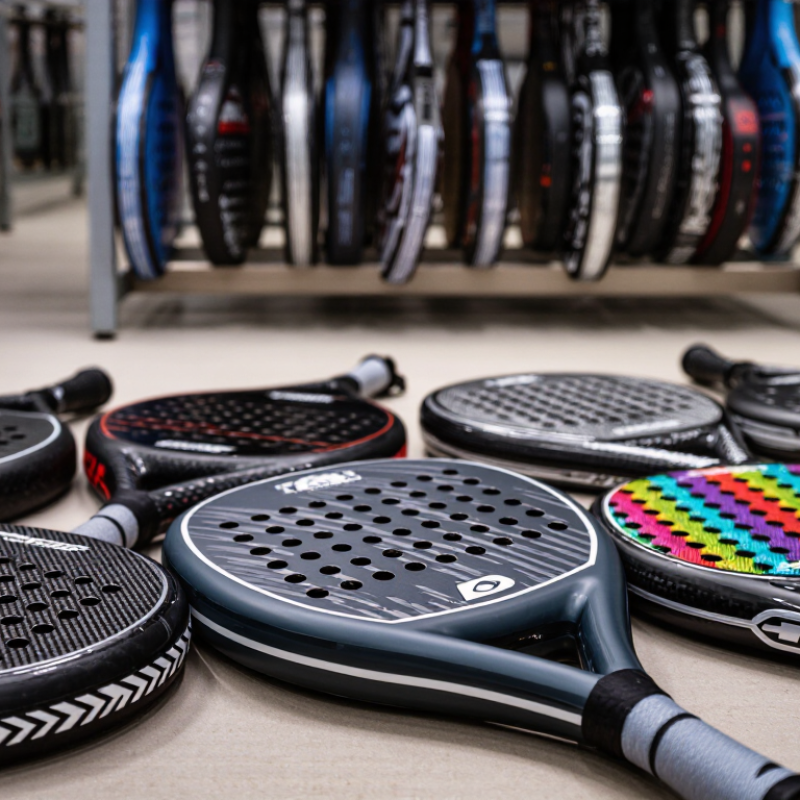
Composite Pickleball Paddles: Materials and Key Features
Composite pickleball paddles pair a layered face with a structured core. Fiberglass faces often feel lively and add pop on compact shots. Carbon-fiber faces are commonly chosen for a firmer, more controlled response. Yet the material name alone tells little: weave, resin, surface finish, and bonding quality all affect feel. Small differences matter.
Most composite paddles use a polymer honeycomb core. Its cells help balance weight, stiffness, and impact absorption, while core thickness can change the response at the kitchen line. A thicker core may feel steadier on blocks; a thinner one can feel quicker, though technique matters more than a simple rule suggests. Edge guards protect the perimeter, but loose guards or uneven bonding may signal weak assembly. Check the face for bubbles and the handle for a secure, comfortable grip.
Weight and balance deserve a real test, not just a specification sheet. A paddle may look light yet feel head-heavy during repeated volleys. Feel it first. Surface texture can support spin, but it wears with use and cannot replace clean contact. A common mistake is treating “composite” as one consistent standard. Ask suppliers for face and core details, weight tolerances, and sample units; published claims should match the paddle in hand. Slight variation still happens. That deserves scrutiny.
China’s Composite Pickleball Paddle Supplier Landscape
China’s composite pickleball paddle supplier landscape includes factories with different levels of design, testing, and customization support. Composite faces and honeycomb-style cores can vary in material, thickness, and finish, so two paddles with similar specifications may feel quite different. Ask suppliers to explain their construction choices in plain terms, not just share a product sheet.
Sampling is essential. Compare several paddles for weight, balance, grip comfort, and edge finish. Check whether the face feels consistent across its surface, and ask how production batches are inspected. A supplier’s answers about tolerances and defect handling can be as useful as its quoted price. Request clear details on minimum order quantities, sample lead times, packaging, and customization charges before approving a run.
Small details matter. A logo or color change may seem simple, but it can affect lead time or require a new sample. Keep written specifications and review a pre-production unit where possible. No supplier is a perfect fit for every buyer, and a polished sample does not guarantee identical bulk quality. That uncertainty deserves a direct conversation, not an assumption.
China’s Composite Pickleball Paddle Supplier Landscape
Typical composite paddle construction highlights the main components suppliers may manufacture or assemble.
Illustrative component count for a typical paddle: two face skins, one core, one edge guard, and one handle-and-grip assembly. Designs vary; this is not a supplier ranking or market-share dataset.
Profiles of Leading Chinese Paddle Manufacturers
Leading Chinese composite pickleball paddle manufacturers differ in how they manage materials and production. Some focus on carbon-fiber faces, where consistent surface texture and careful bonding affect feel and durability. Others offer fiberglass options for buyers seeking a softer touch or lower-cost product. Their profiles are most useful when they describe actual capabilities, not just broad claims.
A capable supplier should explain its core materials, face construction, edge protection, and quality checks. Ask how it tests paddle weight, thickness, surface finish, and bond strength across production batches. A sample can reveal details a specification sheet cannot: the edge guard’s fit, the handle’s grip, and whether the face feels even. Small things matter.
Some factories handle design, pressing, finishing, and packing in-house; others rely on outside partners for certain steps. Neither setup is automatically better. Buyers should check who controls each stage and how defects are recorded. No profile is complete. Even a detailed factory visit may not reflect every production run, so request current samples and written specifications before comparing suppliers.
Manufacturing Capabilities, Quality Standards, and Export Markets
China’s composite pickleball paddle suppliers vary in how much production they control. Some manage fiber cutting, core bonding, pressing, edge finishing, and inspection in one facility. Others rely on outside workshops for certain steps. Ask who handles each stage, and request a clear process description. Details matter. A glossy sample is useful, but it cannot show whether every batch has consistent weight, balance, and surface texture.
Quality standards should be checked through records, not broad promises. Ask for documented checks on paddle dimensions, bonding strength, surface finish, and weight variation. If a supplier cites a certification, confirm its scope and validity with the issuing organization. A small trial order can reveal practical issues, such as rough edge guards or packaging that lets paddles shift in transit. These checks take time. They are not foolproof.
Export readiness also involves more than quoting a low price. Reliable suppliers should explain lead times, carton protection, shipping documents, and how they handle defects or production delays. Request recent examples of shipments to your target region, while respecting customer confidentiality. Some factories communicate well before an order, then become less precise when changes arise. That is worth reflecting on. Clear written specifications, sample approval, and agreed inspection points help reduce avoidable surprises.
How to Compare and Select a Chinese Paddle Supplier
A reliable Chinese composite pickleball paddle supplier should be judged by repeatability, not a polished sample alone. The Sports & Fitness Industry Association’s 2024 Topline Participation Report counted 13.6 million U.S. players in 2023, up 51.8% from 2022. That growth makes production capacity worth checking, but a large factory is not automatically a better partner. Ask for recent production records, documented quality checks, and clear lead times. Request several samples from different production runs. Compare weight, thickness, balance, surface texture, and handle dimensions with calipers and a scale. Small differences matter in play.
Check how the supplier controls composite layup, core bonding, edge-guard attachment, and handle finishing. Ask what tests it performs for face durability, impact resistance, and batch consistency, and request dated results tied to the sample or production lot. Confirm that specifications can be verified against the rules of your intended market before ordering. A useful comparison sheet should include minimum order quantity, tooling fees, sample charges, defect remedies, and delivery terms—not just unit price. One caveat: supplier documents can look complete while saying little about actual consistency. A factory visit or independent pre-shipment inspection may reveal gaps, though it adds time and cost. I would not skip it for a first order.
