
What Are the 2026 Top Promotional Items for Global Buyers?
Global buyers entering 2026 face a promotional market shaped by practicality, sustainability, and regional expectations. The strongest promotional items will not simply look attractive. They should support daily use, communicate a clear brand message, and remain suitable across different markets. Reusable drinkware, recycled-textile bags, desk accessories, compact technology tools, and wellness-focused products may receive strong attention. However, popularity alone does not guarantee a successful campaign. Buyers must examine material quality, production consistency, packaging, and delivery reliability before placing large orders.
Usefulness still wins. Experienced sourcing teams often test samples under real working conditions. A travel mug should resist leaks, not only photograph well. A power accessory should include trustworthy safety documentation and compatible specifications. Branded apparel should offer accurate sizing and color consistency. Promotional items also need responsible customization, especially when they display names, logos, or personal information. Regional recycling rules, product labeling standards, import requirements, and data-protection expectations can affect the final choice. Working with established suppliers and requesting verifiable certifications can reduce avoidable risk.
This 2026 overview will examine practical categories, emerging designs, and purchasing criteria for international buyers. It will also consider cost control, minimum order quantities, lead times, and responsible materials. Trends can mislead. A product may appear sustainable while hiding excessive packaging or weak durability. That is why buyers should compare the complete product lifecycle, not just the unit price. The best promotional items will combine useful design, measurable quality, transparent sourcing, and credible brand value. Forecasts remain imperfect, but careful evaluation can make promotional investment more dependable.
Defining the 2026 Promotional Items Market
What Are the 2026 Top Promotional Items for Global Buyers?
Defining the 2026 Promotional Items Market
Promotional items are useful, physical products that carry a message into everyday life. Think of a sturdy tote at a grocery store, a notebook beside a laptop, or a bottle used on a commute. For global buyers, the market is not just about choosing popular products. It also involves balancing usefulness, product quality, customization, and responsible sourcing. Grand View Research estimated the global promotional products market at USD 25.8 billion in 2023, with projected annual growth of 3.7% from 2024 to 2030. That estimate signals a sizable sector, but it does not tell buyers which products will work best for every audience.
Consumer response offers another useful measure. ASI’s 2023 Ad Impressions Study reported that 83% of U.S. consumers enjoy receiving promotional products. The finding supports practical, well-made items, but U.S. responses should not stand in for global preferences. Climate, culture, and daily habits matter. A lightweight bottle may suit one audience; a compact umbrella may be more useful elsewhere. Useful, not flashy.
Tip: Ask recipients how and where they will use an item before placing a large order. Check material details, print durability, and sample quality. A sample can reveal what a spreadsheet cannot. Even careful research has limits: buyer assumptions can miss real user needs. Build in time to test, revise, and learn from feedback.
What Are the 2026 Top Promotional Items for Global Buyers?
Defining the 2026 Promotional Items Market
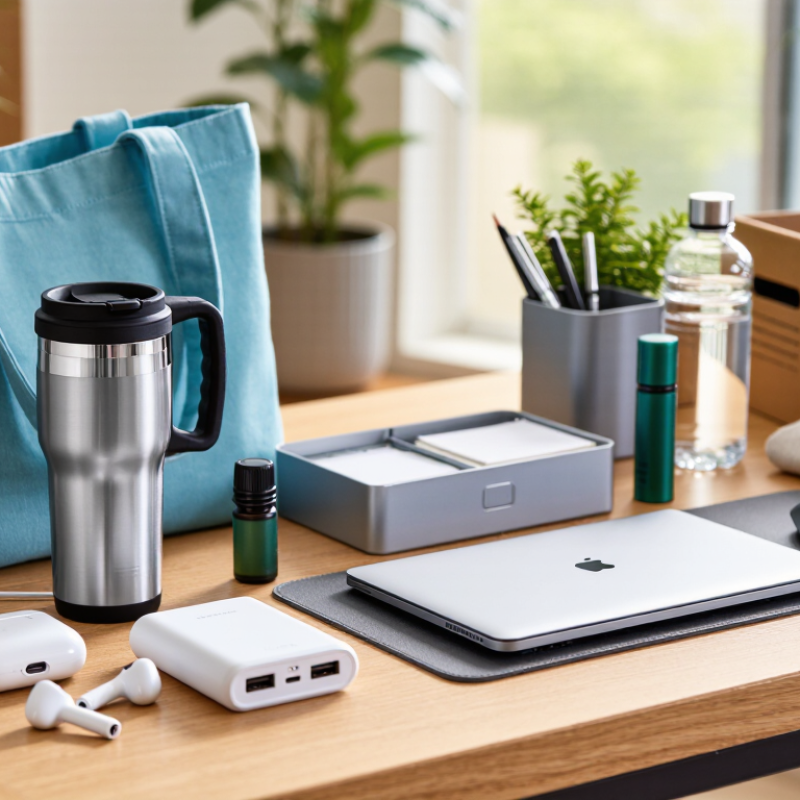
Reusable drinkware, bags, and everyday tech accessories are practical options for global campaigns because they combine repeat use with broad audiences. Scores are an editorial buyer-fit index, not measured sales, market share, or survey results; they summarize general utility, portability, and campaign flexibility.
Identifying Global Buyer Needs and Purchasing Trends
Global buyers entering 2026 are prioritizing useful promotional items over novelty products. Daily-use drinkware, recycled-fiber bags, compact power banks, and travel organizers remain strong candidates. The ASI Ad Impressions Study reports that 85% of recipients remembered an advertiser from a promotional product. Visibility matters, but usefulness creates repeated exposure. A pen may disappear quickly. A durable bottle can travel through airports, offices, and gyms.
Purchasing teams are also asking harder questions about materials, origin, packaging, and replacement rates. PPAI industry research shows sustainability is becoming a practical purchasing criterion, not only a marketing message. Buyers increasingly request recycled content, responsible packaging, and supplier documentation. In Europe, North America, and parts of Asia, these requirements can differ sharply. One universal product plan may fail. Regional sizing, language, climate, and customs rules still shape demand. Small details matter.
Digital work patterns are supporting demand for webcam covers, cable organizers, wireless charging accessories, and desk tools. However, global buyers are not simply chasing technology. The 2024 Global Promotional Products Industry report from PPAI identifies apparel, drinkware, and bags as major product categories, while technology remains an important supporting segment. Forecasts are not promises. Some “green” products may perform poorly if they feel fragile or arrive over-packaged. Buyers should test samples, verify supplier claims, and measure actual reuse before placing large 2026 orders.
Exploring the Top Promotional Product Categories for 2026
What Are the 2026 Top Promotional Items for Global Buyers?
For 2026, promotional product demand is moving toward practical, reusable categories. Drinkware, tote bags, tech accessories, and lightweight apparel remain strong choices. According to Grand View Research, the global promotional products market was valued at about $85.5 billion in 2023. The report also projects steady growth through 2030. Buyers are clearly rewarding usefulness, not novelty alone.
Reusable drinkware works well in offices, conferences, and outdoor events. Compact charging accessories and cable organizers support hybrid work habits. Recycled-fiber bags offer visible space for messages and daily use. The Advertising Specialty Institute’s 2023 Ad Impressions Study reported that promotional products generate an average of 5,038 lifetime impressions. That reach becomes more valuable when an item stays on a desk or travels across borders.
Still, the category choice is not always elegant. A reusable bottle may fail if its coating peels after a few washes. An inexpensive electronic accessory may create waste faster than value. Global buyers should check material documentation, packaging language, production consistency, and shipping durability. Wellness items, notebooks, and desk organizers also deserve attention, especially when buyers want quieter, less disposable merchandise. Small details matter. A useful product with clear care instructions often earns longer engagement than a flashy item.
Evaluating Materials, Technology, Sustainability, and Customization
What Are the 2026 Top Promotional Items for Global Buyers?
Evaluating Materials, Technology, Sustainability, and Customization
Global buyers are choosing promotional items through stricter material checks. Recycled polyester bags remain practical when suppliers provide credible fiber documentation. Reusable stainless steel bottles offer durability, but coatings should resist peeling and odor retention. Bamboo items look natural, yet buyers should verify adhesive safety and responsible sourcing. Appearance alone is not proof of sustainability.
Technology is becoming smaller and more useful. Compact power banks, wireless charging pads, and NFC-enabled cards can support daily business needs. Products should include clear capacity data, charging standards, and safety testing records. A low-cost device with weak battery performance can damage trust quickly. It happens more often than procurement teams expect.
Customization now involves function, not only logos. Buyers can request modular compartments, removable labels, multilingual packaging, or colors matched to local markets. Laser engraving may last longer than surface printing on metal. For textiles, stitching often survives repeated use better than heat transfers. Still, excessive customization can increase waste and minimum order quantities. I have seen attractive designs become impractical after shipping tests. A smaller decoration area may be the wiser choice. Sustainability also depends on packaging, repair options, and end-of-life instructions, not just recycled content.
| Promotional Item | Primary Materials | Technology Features | Sustainability Profile | Customization Options | Durability & Use | Key Global Buyer Considerations |
|---|---|---|---|---|---|---|
| Reusable Stainless-Steel Bottle | Food-grade stainless steel, polypropylene or silicone components | Insulated double-wall versions can maintain beverage temperature; screw or flip lids are common | Reusable format can reduce dependence on single-use beverage containers; recyclable metal at end of life | Laser engraving, screen printing, full-color wrap, lid and color matching | ★★★★★ Suitable for daily commuting, travel, sports and outdoor use | Check food-contact requirements, leak testing, insulation performance, coating durability and packaging recyclability |
| Recycled PET Tote Bag | Fabric made from recycled polyethylene terephthalate, commonly sourced from used plastic bottles | Optional inner pocket, zipper, reinforced handles and foldable construction | Uses recycled polyester feedstock and supports repeated use; actual impact depends on recycled content and product life | Screen printing, heat transfer, embroidery, woven labels and custom bag shapes | ★★★★☆ Lightweight and practical for retail, events and conferences | Request recycled-content documentation, colorfastness testing, handle-strength testing and restrictions on mixed-material components |
| Organic or Recycled Cotton Cap | Organic cotton, recycled cotton, recycled polyester or blended fabric | Adjustable buckle, hook-and-loop closure or structured panels; no integrated electronics required | Organic cotton is grown under defined organic production standards; recycled fibers reduce reliance on virgin textile inputs | Embroidery, woven patch, heat transfer, screen printing and custom labels | ★★★★☆ Useful for outdoor campaigns, uniforms and sports events | Verify fiber composition, color migration, seam quality, sizing range and applicable textile labeling rules |
| Bamboo-Fiber or Recycled-Paper Notebook | Paper from certified or recycled fiber; covers may use paperboard, bamboo fiber or other plant-based composites | Optional elastic closure, document pocket, pen loop and removable page sections | Paper can be recyclable when free from difficult-to-separate coatings and mixed materials; recycled content should be documented | Debossing, foil stamping, screen printing, printed belly bands and custom page layouts | ★★★☆☆ Best for meetings, education, travel and workplace note-taking | Confirm paper basis weight, binding strength, ink and coating specifications, recycled content and recycling instructions |
| USB-C Recycled-Plastic Power Bank | Lithium-ion battery, electronic circuit board and recycled or conventional plastic housing | USB-C input/output, battery-level indicators and overcharge, over-discharge and short-circuit protection | Recycled housing can reduce virgin plastic use; electronic products require responsible battery and e-waste collection | Pad printing, UV printing, laser marking, custom casing colors and retail-ready packaging | ★★★★☆ Practical for travel, trade shows and mobile work | Request battery transport documentation, applicable safety testing, USB-C specifications, capacity verification and recycling guidance |
| Wireless Charging Desk Pad | Recycled polyester, vegan leather or textile surface; copper coil, circuit board and polymer base | Wireless charging for compatible devices; some models include USB-C power input and foreign-object detection | Long-term use can extend product value; mixed materials and electronics make end-of-life separation more difficult | Full-surface printing, debossed logo, edge stitching, custom cable and packaging design | ★★★☆☆ Designed for office desks, hotels, lounges and hybrid-work settings | Check wireless charging compatibility, electrical safety, thermal management, cable quality and claims about recycled content |
| Recycled ABS Bluetooth Tracker Tag | Recycled ABS or other polymer housing, coin-cell battery, speaker and Bluetooth Low Energy electronics | Bluetooth Low Energy connectivity, proximity alerts and smartphone-based item location through a compatible application | Small electronic format requires battery removal or appropriate e-waste handling; recycled housing may lower virgin plastic demand | Printed logo, molded color, serialized packaging and custom instruction cards | ★★★☆☆ Useful for luggage, keys, equipment and event credentials | Review application compatibility, privacy notices, battery regulations, radio requirements and replacement-battery availability |
| Compact Reusable Travel Utensil Set | Stainless steel, wheat-straw-based polymer, recycled plastic or bamboo components | Travel case, snap closure and modular spoon, fork, knife or chopstick configuration | Reusable design can replace disposable cutlery; material recyclability depends on construction and local waste systems | Laser engraving, pad printing, custom case colors and printed instruction cards | ★★★★☆ Suitable for office lunches, travel, catering and outdoor activities | Verify food-contact compliance, dishwasher guidance, sharp-edge safety, odor resistance and separation of mixed materials |
| Recycled-Fabric Laptop Sleeve | Recycled polyester or nylon outer fabric, foam padding, zipper and lining | Padded compartments, water-resistant coating, cable pocket and magnetic or zipper closure | Recycled textile content can reduce virgin-fiber demand; coatings, foam and zippers may complicate recycling | Woven labels, embroidery, heat transfer, all-over printing and custom dimensions | ★★★★☆ Provides lightweight protection for common laptop and tablet sizes | Check abrasion resistance, zipper cycles, padding thickness, water-resistance claims, device-size tolerance and textile labeling |
| Seed Paper Greeting Card or Plantable Tag | Recycled paper embedded with non-invasive plant seeds and water-based inks | No electronic technology; interactive planting instructions create a post-use engagement point | Paper may be recyclable or compostable depending on seed, ink, adhesive and local waste requirements; avoid invasive species | Custom die-cutting, variable data printing, multilingual instructions and themed illustrations | ★★☆☆☆ Best for seasonal campaigns, packaging inserts and event invitations | Confirm seed species by destination market, germination information, paper sourcing, ink composition and import restrictions |
| Buyer note: Sustainability and compliance performance varies by supplier, specification, manufacturing process and destination market. For global procurement, request material declarations, test reports, battery or food-contact documentation where applicable, packaging details and end-of-life instructions before approval. | ||||||
Comparing Suppliers, Costs, Compliance, and International Logistics
What Are the 2026 Top Promotional Items for Global Buyers?
For 2026 campaigns, global buyers are choosing practical products with visible daily use. Reusable bottles, recycled-fabric bags, compact travel organizers, and low-energy desk accessories remain strong options. In supplier comparisons, I look beyond catalog photographs. I request material details, factory location, production capacity, sample approval, and recent quality records. A recycled cotton tote may cost more than a standard polyester bag. However, its material story can support stronger customer engagement. Custom embroidery also affects unit cost, production time, and packaging space.
Cost is only one part of the decision. Buyers should check colorants, coatings, batteries, food-contact materials, and electronic components against destination-market requirements. Compliance documents must match the actual product, not a similar sample. That mistake can create delays. Some suppliers provide attractive certificates, but the testing date or product model may be unclear. I have found that direct questions often reveal more than polished sales presentations. Still, supplier claims need independent verification.
International logistics can change the final price quickly. A lightweight item may reduce freight charges, while bulky packaging can erase that advantage. Buyers should compare air, sea, rail, and consolidated shipment options. They also need clear carton dimensions, gross weight, labeling rules, and delivery terms. A small pre-production shipment can expose weak packing before a large order leaves the factory. My own forecasts are not always accurate when exchange rates, port congestion, or seasonal demand shift. That uncertainty deserves a realistic buffer, not optimistic arithmetic.